Discover the importance of content relevance in SEO and digital marketing. Learn how relevant content, keyword relevance, and link relevance help websites rank higher and connect better with audiences.
Introduction
In the digital era, where search engines decide which pages appear before millions of users, content relevance has become a deciding factor for visibility and engagement. When you publish a blog, article, or webpage, the first thing Google and your audience look for is how relevant your content is to the topic and the search intent. If your content matches what users are looking for, your chances of ranking higher and gaining trust increase dramatically. In simple terms, relevant content is content that answers users’ questions, aligns with their intent, and fits within the topic of discussion.
What Is Content Relevance?
Content relevance refers to how closely your content relates to the user’s search query, topic, and purpose. When a user types a question or keyword into a search engine, Google evaluates whether your page is the most suitable answer for that query. If someone searches for “what is link relevance in SEO,” an article explaining link relevance, backlink strategies, and relevance-based link building will appear higher than a generic piece about online marketing. The relevance of content is therefore about creating material that meets user intent, adds value, and fits contextually within your website’s focus area.
Relevance in SEO and Digital Marketing
In SEO, relevance determines how effectively your content satisfies the needs of both the user and the search engine. For a search engine, relevance refers to how accurately a page addresses a search query’s intent. Algorithms analyze multiple elements such as keywords, backlinks, content depth, and topical context to assess how relevant a page is to a particular search term.
From an audience perspective, relevance to the audience means that the information presented is useful, engaging, and easy to understand. If a digital marketer writes about “affordable SEO tools,” the content should target small business owners or freelancers looking for low-cost solutions. When a page delivers content that aligns with audience expectations, users stay longer, engage more, and are more likely to convert. That’s why relevance of content plays a dual role—it satisfies both search engine algorithms and real human readers.
Topic, Keyword, and Link Relevance
Topic relevance ensures that your website stays focused on one central subject. For example, a website dedicated to SEO should not publish unrelated topics like cooking or travel. Maintaining strong topic relevance helps search engines understand your niche and build authority around it.
Keyword relevance is equally essential because it connects your content to the specific words and phrases users type into Google. A blog about “content relevance” should naturally use related keywords like “relevant content,” “topic relevance,” “keyword relevance,” and “relevance in SEO” throughout the text. This creates a semantic link between your content and the target keyword, signaling to search engines that your page is a credible and focused source on that subject.
Another major element is link relevance, which refers to how closely your backlinks relate to your topic. Backlinks from topically relevant websites improve your site’s authority and ranking power. For example, if a digital marketing website links to your blog about “backlink relevance,” it strengthens your credibility because the link comes from a related and trustworthy source. However, if a link comes from a cooking or unrelated entertainment site, it holds less SEO value. Therefore, relevant link building and backlink relevance are crucial for long-term ranking stability.
Relevance to Audience and Website Authority
Building a relevant website means every page should align with your audience’s interests and your overall niche. If your site is about online marketing, your blogs, guides, and services should all connect to that central topic. A consistent theme builds website relevance and tells search engines that your domain is an authoritative hub for a specific field.
Equally important is audience relevance—understanding who your readers are and what they want to learn. For instance, if your target readers are students learning about SEO, your content should explain concepts like “topic relevance” and “keyword relevance” in simple, educational terms. But if your audience includes advanced marketers, you should focus on deeper analysis such as semantic SEO and contextual link building. The more aligned your content is with audience expectations, the more relevant it becomes, improving both engagement and ranking potential.
Relevance in Online Marketing
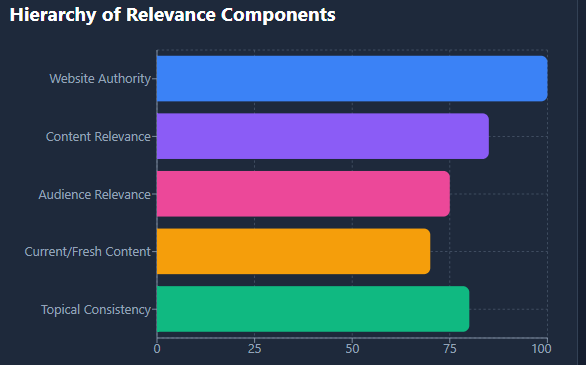
In online marketing, relevance is the foundation of success. Every marketing campaign—from social media posts to email newsletters—relies on content relevance to capture attention. When content is current, useful, and topically relevant, it resonates better with audiences. Search engines reward such efforts by pushing these pages higher in search results. Current relevance is another key factor—outdated data or old trends can quickly reduce content effectiveness. Updating your website regularly helps maintain both freshness and SEO strength, signaling to Google that your site remains valuable in real time.
Example of Relevance in SEO
Imagine a user searching for “best keyword relevance tools.” If your article provides detailed information about keyword research tools like Semrush or Ahrefs, explains how they measure relevance, and includes practical examples, it will be seen as highly relevant content. But if your article diverts to general marketing discussions or talks about web design, it loses focus and becomes irrelevant. Another example can be found in backlink relevance—a link from a digital marketing website to your SEO guide is relevant and valuable, while a link from a random gaming blog holds little to no SEO power.
These examples show that content relevance is all about precision—staying close to the user’s query, matching search intent, and maintaining topical consistency across your site.
Conclusion
The essence of content relevance lies in understanding your audience, your topic, and the intent behind every search. A relevant website doesn’t just use keywords—it delivers meaning, clarity, and value that directly align with what users are searching for. Relevance in SEO ensures that your website is not only discoverable but also trustworthy. By focusing on relevant content, link relevance, and topic relevance, you create a strong foundation for sustainable growth. Ultimately, relevance bridges the gap between what search engines expect and what audiences need, helping your content achieve long-lasting visibility and authority in the digital world.
FAQs About Content Relevance
Q1. What is content relevance in SEO?
Content relevance in SEO means how closely your webpage matches a user’s search intent and provides information that fulfills their expectations.
Q2. What does link relevance mean?
Link relevance refers to backlinks that come from websites and pages related to your topic, strengthening your website’s SEO and authority.
Q3. How can I make my content more relevant to the audience?
To improve audience relevance, focus on understanding your readers’ interests, use current and meaningful examples, and provide updated, topic-specific insights.
Q4. Why is keyword relevance important for SEO?
Keyword relevance ensures your website appears for the right search queries, helping attract targeted traffic that’s genuinely interested in your content.
Q5. What is the relevance of content in online marketing?
In online marketing, relevant content helps brands connect with their audience, enhance engagement, and improve overall visibility on search engines.
My Personal Opinion
In my personal opinion, content relevance is the foundation of every successful digital marketing effort. It’s not just about adding keywords or following search trends — it’s about understanding what your audience truly wants and delivering it in the most valuable way. I believe relevance is a balance between creativity and strategy. Search engines reward relevance, but readers sustain it. When your content genuinely helps people, provides updated insights, and connects emotionally, its SEO performance automatically improves.
From my perspective, every marketer should prioritize relevance over volume. Publishing hundreds of articles that aren’t topically relevant or connected to your main niche doesn’t add real value. Instead, one well-researched, audience-focused, and topically relevant article can outperform dozens of generic ones. Relevance builds trust, and trust builds long-term visibility. That’s the real power of creating relevant content in today’s competitive online world.


0 Comments